TL;DR
To measure AI visibility, run a fixed set of real buyer prompts across the AI tools your market uses, repeat each prompt several times, and record whether your brand is mentioned, cited as a source, or recommended, alongside the competitors that appear. Turn those records into share of voice and accuracy checks over time, and pair them with AI referral traffic in GA4. Search Console helps less than you might expect, because AI Overviews and AI Mode data sits inside its normal Web search totals. Because answers vary between runs, trends across weeks matter more than any single result.
How to measure AI visibility: decide what you are counting
Most confusion about AI visibility comes from lumping different outcomes together. Before you track anything, separate the three ways your brand can show up in an AI answer. We introduced these in what AI brand mentions SEO is; here is how each one translates into something you can record.
| Signal | What it means | What to record |
|---|---|---|
| Mention | The answer names your brand in its text | Yes or no, plus where in the answer it appears |
| Citation | One of your pages is listed as a source or link | Which URL was cited, and whether your brand was also named |
| Recommendation | The answer suggests your product as a fit for the buyer's need | Whether you were recommended, listed neutrally, or advised against |
These do not always travel together. Your docs can be cited while the answer recommends a competitor. Your brand can be named from training data with no citation at all. A good tracking setup records each one separately, because each points to a different fix.
Build a prompt set that reflects real buyers
Your prompt set is the equivalent of a keyword list for rank tracking. If it is built from guesses, every number downstream is noise. Build it like this:
- Start from what buyers actually ask. If you already have a keyword list, our comparison of GEO and traditional SEO explains why prompts need different phrasing. Pull questions from sales call notes, demo requests, support tickets, and the comparison searches already in your Search Console data.
- Cover five intent types: category discovery ("best SOC 2 automation tool for startups"), comparisons ("your brand vs. a named competitor"), alternatives ("alternatives to a named competitor"), problem-led questions ("how can our team reduce failed webhook deliveries"), and brand facts ("does your brand support SSO").
- Write prompts the way people type into AI tools: full sentences with context, not two-word keywords.
- Fix the wording once you start. Changing a prompt resets its history, so add new prompts rather than editing old ones.
- Tag each prompt by intent, product line and funnel stage so you can report on groups, not just individual prompts.
- Choose the platforms to cover. For most B2B software that means ChatGPT, Google AI Overviews and AI Mode, Perplexity and Gemini, with Claude and Copilot if your buyers use them.
- Start with a set you can actually review by hand, often 15 to 20 prompts, and expand once the process is routine.
AI visibility metrics worth tracking
Presence rate
The simplest metric: out of all the answers you collected, how many mention your brand. Track it per platform and per intent group, since you may be strong on brand fact prompts and missing from category discovery prompts, which is a very different problem.
Share of voice
Share of voice compares your presence with your competitors' across the same prompts. As a hypothetical illustration: if you run 20 prompts three times each, you have 60 answers. If your brand appears in 15 of them and your main competitor appears in 30, the competitor's share of voice is twice yours on that prompt set. The absolute number matters less than the gap and the direction it moves.
Citation share
Record which domains get cited for each prompt, yours and everyone else's. This is where AI citations become actionable: if the same review site or comparison article keeps appearing as a source for your category, that page is shaping answers, and you should know whether it mentions you. If your own pages are rarely cited, our guide to content that gets cited by AI covers what to change.
Position and framing
Being the first product named in a list reads differently from being the fifth, and "a strong choice for teams that need X" reads differently from "also exists". A simple scale works: recommended first, recommended, listed neutrally, mentioned with caveats, advised against.
Sentiment and accuracy
Check every answer that mentions you for factual errors: wrong pricing, missing integrations, a discontinued plan, a feature you never had. Accuracy problems are often the fastest wins, because the fix is usually clearer facts on your own crawlable pages and corrected information on the third-party pages the answers cite.
Dealing with variance between runs
AI answers are not stable the way rankings are. The same prompt can produce different brands, sources and wording on two consecutive runs. Answers also shift with the user's location, account history and personalization settings, and with model updates the vendor rolls out without notice. A single screenshot proves very little.
- Run each prompt several times per check and record every run, not just the best one.
- Keep conditions consistent: same platforms, same region, logged-out or clean sessions where possible, and a note of the model or mode used.
- Log the date of every run so you can line up changes with model updates or your own work.
- Judge progress on trends across weeks or months. A one-week swing is usually noise.
Measuring AI referral traffic in GA4
Visibility is the leading indicator. Traffic is the one your finance team cares about. In GA4, visits from AI tools usually arrive as referrals, with sources such as chatgpt.com, perplexity.ai, gemini.google.com, copilot.microsoft.com and claude.ai. ChatGPT also commonly adds a utm_source=chatgpt.com parameter to the links it shows.
Create a custom channel group with an "AI assistants" channel that matches those sources with a regular expression, and place it above the default Referral channel so the traffic is not absorbed there. Then compare engagement and conversion rates for that channel against organic search. Add an "AI assistant" option to any "how did you hear about us" field on your demo or signup form, because self-reported attribution catches visits that analytics cannot.
Know the gaps. Clicks from Google AI Overviews and AI Mode arrive as ordinary Google organic traffic and cannot be separated in GA4. Some visits from AI apps arrive with no referrer and land in Direct. And many AI answers satisfy the user with no click at all. Treat AI referral traffic as a floor, not the full picture.
What Search Console can and cannot tell you
Google counts impressions and clicks from AI Overviews and AI Mode inside the normal Web search totals in Search Console. There is no separate report or filter that isolates them, so you cannot see directly which queries triggered an AI feature that showed your page.
You can still use it for context. Watch long, question-shaped queries, since those are the ones most likely to trigger AI features, and watch for pages where impressions rise while clicks stay flat. Neither proves AI involvement on its own, but both are worth cross-checking against your prompt tracking.
Choosing an AI brand visibility tracker
Dedicated AI brand visibility tracking tools now exist, including Ahrefs Brand Radar and a growing number of specialist products. We do not rank vendors here, because the right choice depends on your platforms and budget. What to check before you commit:
- Which AI platforms and modes it covers, and whether that matches where your buyers search.
- Whether you can supply your own prompts, or only use prompts the tool generates.
- How many times it runs each prompt and how often, since a single run per month says little.
- Whether it captures the cited URLs, not only brand mentions.
- Whether it tracks competitors on the same prompts, so you can calculate share of voice.
- Whether you can export raw answers, so you can check accuracy yourself.
A spreadsheet and a few hours a month is a perfectly good start. It forces you to read the answers, which is where the useful findings are. Move to a tool when the manual process stops scaling.
What an AI visibility report looks like
Here is the AI responses panel Ahrefs shows for APIFreaks, a newer in-house project of our founder, on October 27, 2026: 265 AI responses across all tracked platforms, 211 of them in Google AI Overviews, with the change over the last seven days next to each number.
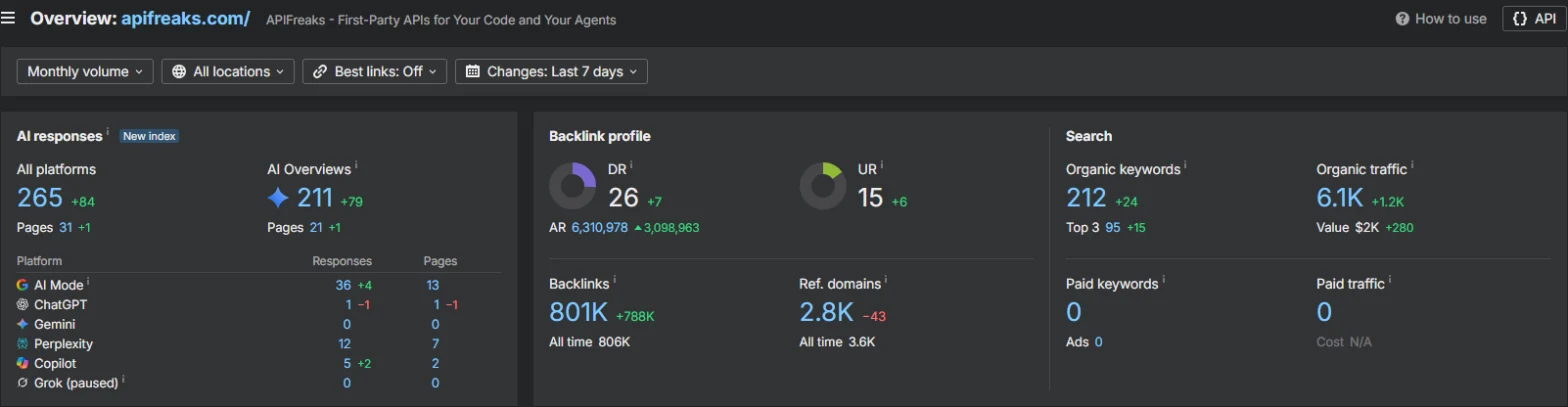
Two things are worth copying into your own tracking: the split by platform, since one total hides very different results per assistant, and the change column, since single readings swing between runs. Treat numbers like these as directional estimates from the prompts a tool tracks, not a count of every answer.
These are Furqan Ashraf's in-house SEO projects, not Chung Digital client engagements. The figures are sitewide Ahrefs estimates and reflect combined SEO, content, product and technical work. Furqan's role focused mainly on off-page SEO, publisher outreach, backlink strategy and authority building. AI response counts are Ahrefs estimates from the prompts it tracks, and they are never the result of one person's work alone.
How Chung Digital measures AI visibility
Measurement is built into our Mentions plans rather than sold separately. As a generative engine optimization agency, we start with a baseline audit across ChatGPT, Gemini, Perplexity and AI Overviews, then track a fixed prompt set every month: 15 to 20 prompts on Starter, 40 to 50 on Growth, and 100+ across all major AI platforms on Authority. Growth adds a competitor citation gap analysis, and Authority adds a quarterly competitive benchmark report.
Each monthly visibility report shows where you were mentioned, cited and recommended, where you were not, and which third-party sources shaped the answers. That last part tells us where brand mention placements are likely to matter most, a trade-off we cover in backlinks vs. brand mentions for AI visibility. We cannot guarantee citations, because no one controls what a model writes. The point of the report is to show honestly what moved, what did not, and what we plan to do next.
Frequently asked questions
How often should we check AI visibility?
Monthly is a sensible default for most SaaS teams, with several runs per prompt each time. Weekly checks make sense around a launch, a pricing change, or a big content update. Checking daily mostly measures noise.
Can we see AI Overviews data in Search Console?
Not separately. Impressions and clicks from AI Overviews and AI Mode are included in the regular Web search totals, with no dedicated filter. Use Search Console for context and rely on prompt tracking for AI-specific visibility.
Why do colleagues get different answers to the same prompt?
AI answers vary with location, account history, personalization settings, the model or mode selected, and simple randomness in how the model writes. That is normal behavior, not a tracking error. It is why consistent conditions and repeated runs matter.
Is AI referral traffic a good KPI on its own?
It is useful but incomplete. Many AI answers produce no click, some app traffic arrives without a referrer, and clicks from Google's AI features count as organic. Pair referral traffic with prompt-level visibility and self-reported attribution.
Should branded prompts be part of the prompt set?
Yes. Prompts that ask about your product directly, such as pricing, integrations or security, are where factual errors show up. Keep them in a separate group so they do not inflate your share of voice on category prompts.
Do tracking tools see the same answers real users see?
Not exactly. Tools collect answers through APIs or automated sessions, which may differ from what a logged-in user with personal history sees. Treat tool data as a consistent sample for spotting trends, not a perfect copy of every user's experience.
What is a good AI share of voice?
There is no universal benchmark, because it depends on how crowded your category is and how many competitors you track. The useful comparison is against your closest competitors on the same prompts, and against your own baseline over time.
How do we connect AI visibility to pipeline?
Combine three sources: AI referral traffic and its conversions in GA4, an AI assistant option in your how-did-you-hear-about-us field, and notes from sales calls when prospects mention an AI tool. None is complete alone, but together they show whether visibility is reaching buyers.