TL;DR
Generative engine optimization vs. traditional SEO is less a rivalry than a change in what counts as winning: traditional SEO aims for a ranked link that earns a click, while GEO aims to get your brand named, cited, or recommended inside an AI-generated answer. The foundations overlap heavily, because the AI search features in Google, ChatGPT and Perplexity pull from crawled, indexed web pages. What changes is the unit of success, the shape of the query, how much your off-site reputation counts, and how you measure progress. Most SaaS teams need both, run as one program rather than two competing budgets.
Generative engine optimization vs. traditional SEO: the short version
Traditional SEO is the work of getting your pages to rank in a list of results, so a searcher clicks through to your site. Generative engine optimization (GEO) is the work of getting your brand and your pages used inside an answer that an AI system writes, in Google AI Overviews and AI Mode, ChatGPT, Perplexity, Gemini, Claude and similar tools.
The two are often sold as opposites. They are not. A large share of GEO is ordinary SEO done well, and a page that cannot be crawled or indexed is invisible to both. The differences are real, though, and they change what a SaaS team should prioritize, write, build off-site, and report on. If you want the full definition first, start with our explainer on what generative engine optimization is. This post assumes you know the basics and focuses on where the two disciplines split.
What stays the same
The overlap is bigger than most GEO pitches admit. These things matter in both worlds, and neglecting them sinks both:
- Crawlability and indexing. Google says there are no special technical requirements to appear in AI Overviews beyond being indexed and eligible to show a snippet. If Googlebot cannot reach a page, it cannot rank and it cannot be cited.
- Crawler access for each platform. ChatGPT search relies on OpenAI's OAI-SearchBot, which is separate from GPTBot, the crawler OpenAI uses for model training. Blocking the wrong one in robots.txt can quietly remove you from AI answers. A quick pass with a robots.txt tester catches this.
- Relevance to the query. A page has to actually answer the question, whether a ranking algorithm or a language model is doing the choosing.
- Authority and trust. Search engines lean on links and other signals of reputation. AI search features retrieve from those same indexes, so a site search engines already trust starts with an advantage.
- Clean technical SEO. Fast pages, sensible canonicals, server-rendered content that does not depend on heavy JavaScript to show its main text. Every crawler benefits from that.
This is why we push back when a team wants to pause SEO to fund GEO. On Google in particular, the path into AI Overviews runs through the same index and the same quality systems as organic results. Our guide on how to rank in Google AI Overviews covers that platform in detail.
What's actually different
The unit of success: a position vs. a place in the answer
In traditional SEO, the result is a position on a page. You rank third for a keyword, and you can watch that number move. In GEO, the result is whether you appear in the answer at all, and in what role. Your brand can be named as a recommendation, your page can be cited as a source without your brand being named, or a competitor can be recommended using facts taken from your page. Those are different outcomes, and only some of them help you.
The query: keywords vs. prompts
People type short keywords into a search box. They write longer, more specific prompts into AI tools, often with constraints attached: team size, budget, compliance needs, the stack they already use. A prompt like "which API monitoring tool works for a small team already running Kubernetes" has no clean keyword equivalent. Google has also described its AI Mode as breaking a question into several related searches behind the scenes (it calls this query fan-out), so a single prompt can pull in pages that rank for a range of sub-questions, not just the head term.
Where the evidence comes from: your site vs. the wider web
Traditional SEO is mostly about your pages, with backlinks as the main off-site input. AI answers that recommend products tend to synthesize from many sources at once: review sites, comparison articles, community threads, documentation, news. Our inference from how these systems work is that consistent third-party mentions carry more weight in a generated recommendation than in a ranked list, because the model is effectively summarizing what the web says about a category. We unpack that in backlinks vs. brand mentions for AI visibility.
Clicks, attribution and stability
A ranking usually produces a click you can trace. An AI answer may satisfy the reader without any click, or send a visitor whose referrer is stripped by an app. Results also behave differently over time. Rankings are fairly stable day to day, while AI answers can change between two runs of the same prompt, between users, and between model versions. That makes GEO reporting a sampling exercise, not a rank check.
GEO vs. SEO comparison table
| Traditional SEO | Generative engine optimization | |
|---|---|---|
| Goal | Rank a page high in a list of results | Get named, cited, or recommended inside an AI answer |
| Typical input | Short keywords with known search volume | Longer conversational prompts with context and constraints |
| Main on-site work | Keyword targeting, technical health, internal links | Same foundation, plus clear, quotable passages and accurate product facts |
| Main off-site work | Earning relevant backlinks | Backlinks plus brand mentions in the sources AI tools draw from |
| What a win looks like | A position and a click | Your brand in the answer, ideally framed accurately and with a link |
| How it is measured | Rank trackers, Search Console, analytics | Prompt tracking across platforms, share of voice, AI referral traffic |
| Result stability | Fairly stable, changes with updates | Varies by run, user, location and model version |
| Who controls the output | Search engine ranking systems | Search systems plus a language model that writes the answer |
Reading down the right-hand column, notice that almost nothing replaces the left-hand column. GEO adds a layer on top of SEO, it does not swap one out for the other.
Generative engine optimization strategies that build on SEO
If you already run SEO, you do not need a parallel program. You need to adjust the one you have. This is the order we would work in:
- Confirm the foundation. Check that your key pages are indexed, snippet-eligible, and not blocked for OAI-SearchBot, PerplexityBot or Googlebot. GEO work on a page no crawler can read is wasted.
- Turn your keyword list into a prompt list. For each commercial keyword, write the three or four ways a buyer would actually ask an AI tool about it, including comparisons with named competitors and use-case questions.
- Run those prompts and record who gets named. This gives you a baseline and shows which competitors, review sites and publications the answers lean on. Our guide to content that gets cited by AI explains what to change on the pages you find.
- Fix the facts about your own product. Make pricing, integrations, limits, security and use cases easy to find on crawlable pages, written in plain sentences, so answers that do mention you get the details right.
- Extend off-site work beyond links. Keep building relevant backlinks, and add brand mentions on the third-party pages that already appear in answers for your category.
- Report on both layers. Keep rankings and organic traffic, and add prompt-level visibility and AI referral traffic. Review the two together each month rather than in separate decks.
Each step reuses something an SEO program already has: the keyword research, the technical audit, the content calendar, the outreach list. That is the practical case for running GEO and SEO as one plan.
Where AI search optimization advice goes wrong
Because GEO is new, a lot of confident advice is untested. These are the claims we see most that do not hold up:
- "SEO is dead, switch everything to GEO." AI features on Google draw from the same index as organic results, and other AI tools run live web searches. Dropping SEO weakens the inputs GEO depends on.
- "Add an llms.txt file and AI tools will cite you." llms.txt is a proposed convention. No major search engine has confirmed using it. It is cheap to add with a generator, but treat it as optional housekeeping, not a strategy.
- "Block Google-Extended to protect your content." Google-Extended controls whether your content can be used for Google's Gemini models outside Search. It does not affect Search or AI Overviews, so it neither helps nor hurts visibility there.
- "Write for the robot." Pages stuffed with question-and-answer filler read badly to humans and offer no real reason for an AI system to prefer them over a source with actual substance.
- "We guarantee AI citations." Nobody controls what a language model writes. A vendor can improve your odds and measure the result, not promise an outcome.
SEO and GEO metrics side by side
One Ahrefs screen shows why we treat the two as related but separate. For IPGeolocation.io, an in-house project of our founder, on October 27, 2026: DR 72, 4.2K organic keywords and about 115K estimated monthly organic traffic on the SEO side, and about 1.7K AI responses on the GEO side, with 1.2K in AI Overviews but only 12 in ChatGPT.
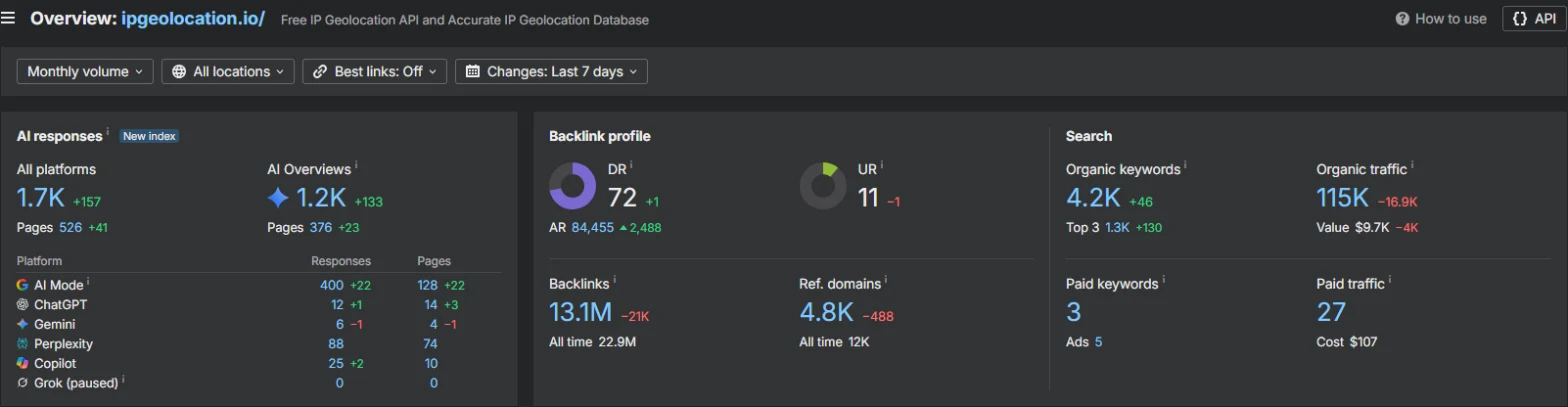
Strong classic SEO clearly feeds Google's AI features, which draw on the same index. It does far less for assistants that choose sources their own way. That, in practice, is the difference between the two disciplines.
These are Furqan Ashraf's in-house SEO projects, not Chung Digital client engagements. The figures are sitewide Ahrefs estimates and reflect combined SEO, content, product and technical work. Furqan's role focused mainly on off-page SEO, publisher outreach, backlink strategy and authority building. AI response counts are Ahrefs estimates from the prompts it tracks, and they are never the result of one person's work alone.
How Chung Digital runs GEO alongside SEO
We treat GEO as an extension of SEO rather than a separate product line. As a generative engine optimization agency, our Mentions work starts with a baseline audit across ChatGPT, Gemini, Perplexity and AI Overviews, then tracks a fixed set of buyer prompts every month and places brand mentions on relevant third-party sites. Where the gap is mostly classic SEO, crawl issues, thin pages, a weak link profile, we say so, because fixing that first is usually the cheaper win.
We cannot promise that any AI tool will name you, and neither can anyone else. What we can do is make sure the facts about your product are clear and consistent across the web, track the prompts that matter to your pipeline, and show you honestly what moved and what did not.
Frequently asked questions
Is GEO replacing SEO?
No. Google's AI features draw on the same index as its organic results, and tools like ChatGPT and Perplexity run live web searches before answering. GEO depends on the same crawlability, relevance and authority that SEO builds, so it works as a layer on top of SEO rather than a replacement.
Is AI search optimization the same thing as GEO?
Mostly, yes. AI search optimization, answer engine optimization (AEO), and LLM optimization are overlapping labels for the same goal: appearing inside AI-generated answers. Vendors use them slightly differently, so ask what work is actually included rather than relying on the label.
Does ranking well on Google help with AI Overviews?
It helps, because AI Overviews pull from pages in Google's index and Google says the usual SEO best practices apply. It is not a strict rule, though: a page outside the top results can still be linked in an AI Overview, and a top-ranking page is not always used.
Does blocking GPTBot remove a site from ChatGPT answers?
Not by itself. OpenAI uses GPTBot for model training and OAI-SearchBot for ChatGPT's search results, and the two are controlled separately in robots.txt. If you want to appear in ChatGPT search answers, OAI-SearchBot needs access to your pages.
How long does GEO take compared with SEO?
Some changes show up quickly, because tools that search the live web can pick up a new or updated page as soon as it is indexed. Building the broad third-party reputation that drives recommendations takes as long as any off-site program, usually months. Answers that rely on a model's training data change only when the model is updated.
Which AI platforms should a SaaS company focus on first?
Start with the ones your buyers actually use, which for most B2B software means Google AI Overviews and ChatGPT, then Perplexity, Gemini and Claude. Ask a few customers where they research tools. Your analytics referral data will also show which AI tools already send visitors.
Do we need a separate team or agency for GEO?
Not necessarily. The skills overlap heavily with technical SEO, content and outreach, so an existing SEO team can absorb much of it. What usually needs adding is prompt tracking and a deliberate brand mention program, which is where specialist help tends to pay off.
Is GEO worth it for an early-stage SaaS company?
It is worth a baseline check early, because it is cheap to see whether AI tools describe you accurately or at all. Heavy investment makes more sense once your core pages are indexed and your category has real buyer prompts. Before that, foundational SEO usually returns more.