TL;DR
To increase domain rating, earn followed links from domains that have never linked to you before, prioritizing strong sites that link out sparingly, and protect the referring domains you already have. Ahrefs Domain Rating counts unique referring domains and their strength on a relative, logarithmic scale, so more links from the same site, nofollow links, and internal links barely move it, and it can slip when the rest of the web grows faster than you. Google does not use DR, so treat it as a progress gauge for link building, not the goal itself.
How Ahrefs domain rating works, in the parts that matter for growth
Domain Rating is Ahrefs' score for the strength of a site's backlink profile, on a scale from 0 to 100. If you want the full comparison with Moz's metric, we covered it in Domain Rating vs. Domain Authority. Here we only need the parts of the formula that tell you what to do.
- Unique domains drive it. DR looks at how many distinct domains link to you with at least one followed link. The second, tenth, or hundredth link from the same domain adds little or nothing.
- Strength of the linking domain matters. A link from a domain with a high DR carries more weight than one from a domain with a low DR.
- Restraint of the linking domain matters too. Ahrefs divides a linking site's weight across all the domains it links out to, so a strong site that links to few domains passes more than a strong site that links to everyone.
- The scale is logarithmic. Each step up the scale takes more new link strength than the step before it, so growth naturally slows as your DR rises.
- It is relative. Your DR is calculated against every other site in the Ahrefs index. If the web's top sites gain links faster than you, your score can stay flat or dip even while you build links.
Just as important is what DR ignores: traffic, content quality, topical relevance, and whether the link sits on a page anyone reads. That is why DR is a useful gauge of link building progress and a poor stand in for SEO progress as a whole.
Why your DR can drop when you did nothing wrong
A DR dip is one of the most common reasons SaaS founders message their SEO team in a panic. Most of the time the cause is one of these, and only some of them need action.
- Lost referring domains: a linking page was deleted, a site was redesigned and dropped old content, or a domain expired. This one is worth checking.
- A link changed attributes: a site switched its outbound links to nofollow or sponsored, so they stopped counting toward DR.
- Your linking domains got weaker: if the sites that link to you lose links themselves, the weight they pass to you shrinks.
- Your linking domains started linking out more: a site that used to link to a few domains now links to many, so its weight is split more thinly.
- The rest of the index grew: because DR is relative, strong growth at the top of the web can nudge everyone else down.
- Ahrefs changed its crawl or formula: both the index and the method get updated, and a small shift across the board is not about you.
The rule we use: a one or two point wobble is noise, a sustained slide over several months is a signal. When you see a slide, open the lost referring domains report first, because that is the cause you can actually fix.
What moves DR and what doesn't
Most wasted link building budget goes on activities that look productive in a report but barely touch DR. This table sorts the common ones.
| Activity | Effect on DR | Why |
|---|---|---|
| Followed link from a domain that has never linked to you | Moves it | Adds a new unique referring domain, the core input |
| Followed link from a strong domain that links out to few sites | Moves it the most | High strength, shared across few targets |
| More links from a domain that already links to you | Little or none | DR counts the domain once |
| Sitewide footer or blogroll link | Counts once | Thousands of pages, still one referring domain |
| Nofollow, ugc or sponsored links | None | Only followed links count toward DR |
| Internal links between your own pages | None | DR measures links from other domains |
| Disavowing links in Search Console | None | Ahrefs cannot see your disavow file |
| Publishing more content | Not directly | Only helps if the content earns new referring domains |
Two of those rows are worth underlining. Disavowing is a Google tool, so it will not lower or raise DR, and you should only use it for genuinely harmful links, not to tidy up a metric. And more content does nothing for DR by itself. It helps only when it gives other sites a reason to link.
How to increase Ahrefs domain rating: the levers that work
Once you know DR rewards new, strong, followed referring domains, the strategy narrows to four levers. For the full menu of link tactics, see our guide on how to get backlinks for a SaaS company. Below is how to aim those tactics at DR specifically.
Diversify where links come from
Look at your referring domains and count how many of your links come from the same handful of partners, communities, or directories. If a few sites account for most of your links, adding more from them is the slowest possible way to grow DR. Every outreach list should be filtered against your existing referring domains first, so that each new placement is a first link from that site.
Favor strong sites that link out sparingly
Two sites with the same DR are not equal sources. One that links out to a small number of carefully chosen domains passes more weight than one whose every post carries a dozen outbound links. When vetting, check the linked domains count in Ahrefs alongside the site's DR. A site whose outbound links far outnumber its own referring domains is often a link seller, and it is weak for DR as well as risky.
Protect and reclaim links you already earned
Every lost referring domain is DR you already paid for. Review lost links each month and contact the sites that dropped a link during a redesign or content refresh. Separately, check which of your own URLs have backlinks but now return a 404, often old blog posts, retired features, or changed docs paths. Redirect each one to the closest live page so the links keep doing their job for visitors and search engines.
Give strong sites a reason to link
The strongest domains rarely link to product pages. They link to things they can cite: a clear explanation of a technical concept, a free tool, a benchmark from your own product data, or a reference page that answers a narrow question better than anything else. One or two assets like that make every outreach campaign aimed at high DR sites far easier.
A monthly routine to increase domain rating
DR growth comes from steady, boring repetition. This is the loop we would run for a SaaS site of any size.
- Export your current referring domains from Ahrefs. This is the exclusion list for all outreach this month.
- Open the lost referring domains report. Flag anything from a relevant site and send a short note asking for the link to be restored.
- Check your own broken pages that still have backlinks and add redirects to the closest matching live page.
- Build this month's prospect list from sites that are relevant to your buyers, have real organic traffic, and do not already link to you.
- Sort prospects by DR and by how many domains they link out to, so the strongest and most selective sites get your best pitches and content.
- Point new links at the pages that need to rank (product, integration, comparison, and docs pages), not only the homepage. DR is sitewide, but rankings are page by page.
- Record every new link with its date, anchor, target URL, and whether it is followed, so you can match DR movement to real changes.
- Review DR, referring domains, and rankings on target pages together at the end of the month. Judge the trend over a quarter, not a single reading.
What to expect: pace and plateaus
Because the scale is logarithmic, early gains come faster. A new SaaS site with few referring domains can see clear movement from a modest number of good links, while an established site needs much more link strength for each extra point. That is not a sign the work stopped working, it is how the scale is built.
Expect plateaus. DR often holds flat for a while and then steps up as Ahrefs discovers new links, or as a few strong placements land in the same period. Judge it on a rolling three month view, and always next to referring domain growth. If referring domains are climbing and DR is flat, the profile is still getting stronger; if both are flat, the link building pace is too slow.
If you are unsure how much link building your category needs, compare your referring domains with the sites ranking for your target keywords. Our post on how many backlinks a SaaS site needs walks through that gap analysis.
Should you chase DR at all?
Partly. Google does not use Domain Rating, and has said it does not use third party authority scores. DR is useful because it tracks something Google does care about, the number and strength of sites vouching for you, but the score itself is a proxy.
That matters most when someone offers to raise your DR fast. Packages sold as a DR boost usually rely on networks of sites that exist to link out, which can lift the number in Ahrefs while adding links Google is built to ignore or that break its link spam policies. A site whose DR jumped while its traffic stayed flat is easy to spot, both for Google and for any publisher vetting you later.
Use DR as the progress gauge for a link building program aimed at relevant, editorial links. If those links are good, DR rises as a side effect. If DR rises from links nobody in your market would ever read, you have improved a number and not much else.
Proof: DR growth on our founder's in-house projects
Here is what the levers above look like over two years on a real site. WHOISFreaks, one of the in-house brands where Furqan runs off-page SEO, had an average Domain Rating of 43 and 340 referring domains in November 2024, according to Ahrefs. By October 2026 Ahrefs showed an average DR of 64 and 4,651 referring domains.
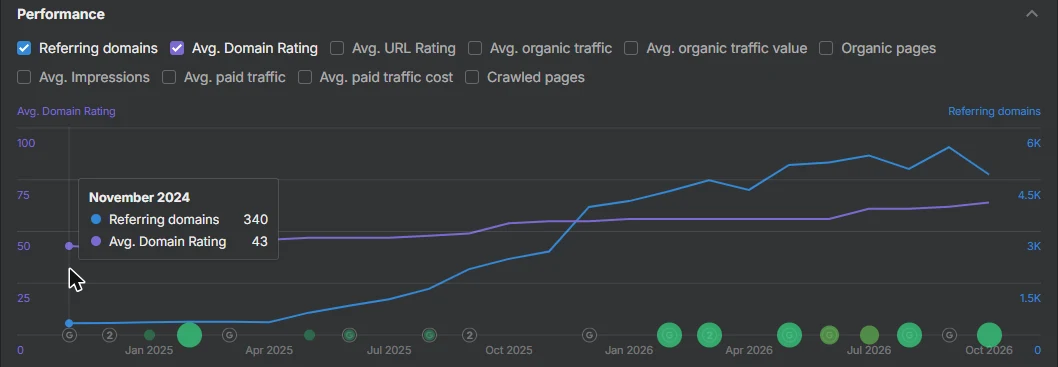
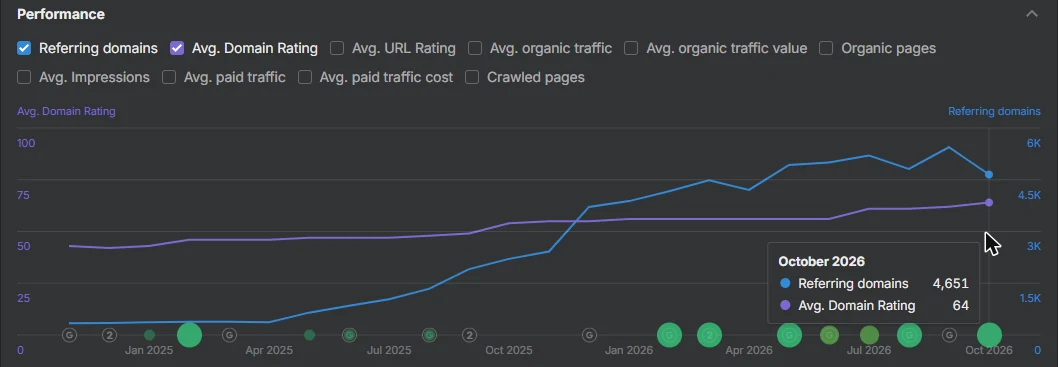
Notice the shape. DR climbs in steps and trails the referring domain line, it does not rise in a straight line. That lag is normal, and it is why we report referring domains every month and treat DR as the slower result.
These are Furqan Ashraf's in-house SEO projects, not Chung Digital client engagements. The figures are sitewide Ahrefs estimates and reflect combined SEO, content, product and technical work. Furqan's role focused mainly on off-page SEO, publisher outreach, backlink strategy and authority building.
How Chung Digital approaches DR growth
We build for referring domain growth from relevant SaaS, API, and B2B tech publishers, and let DR follow. In practice that means outreach lists filtered against your existing referring domains, manual vetting of each publisher, and placements aimed at the pages you need to rank, with an anchor text and target URL plan from the Growth tier up.
Every month you get a report with each live URL, anchor, and date, so you can watch DR, referring domains, and rankings in your own Ahrefs account and judge the work yourself. If you want that loop run for you, compare the link building packages and pick the pace that fits your category. Plans are month to month.
We do not promise a DR number by a date, or the rankings that are supposed to come with it. Ahrefs controls the formula and Google controls the rankings, and nobody outside either company can guarantee them.
Frequently asked questions
How long does it take to increase Domain Rating?
It depends on where you start and how fast you add new referring domains. Low scores tend to move sooner because the scale is logarithmic, while higher scores need much more link strength for each point. Judge progress over a few months, not a few weeks.
Does Domain Rating affect Google rankings?
Not directly. Google does not use Ahrefs DR. The score tends to rise when a site earns links from many strong sites, which Google does value, so DR and rankings often move together without one causing the other.
Can I increase my Domain Rating for free?
Yes, with time instead of money. Reclaiming lost links, fixing broken pages that have backlinks, publishing assets other sites want to cite, and contributing expert input to publications all cost effort rather than budget. Paid programs mainly buy speed and consistency.
Do links from high DR sites always help more?
They help DR more when the site also links out sparingly and the link is followed. For rankings, relevance and real traffic matter as much as the linking site's score, so a smaller site your buyers read can beat a bigger irrelevant one.
Why is my DR lower than a competitor's with fewer backlinks?
DR counts unique referring domains and their strength, not total backlinks. A competitor with fewer links from more distinct, stronger domains will usually score higher than a site with many links from a few sources.
Will buying a DR boost package hurt my site?
It can. Most fast DR packages use sites that exist only to sell links, which Google's link spam policies target. At best Google ignores those links, at worst they create a pattern that undermines trust in the rest of your profile.
Does Domain Rating matter for AI search visibility?
No AI assistant is known to use Ahrefs DR. The links and mentions that raise DR can also make your brand easier for AI systems to find and corroborate, but the score itself plays no role in which sources they cite.