TL;DR
How many backlinks a website needs has no universal answer: it depends on how many referring domains the pages already ranking for your target keyword have, and on how far your own page sits from that range. For a SaaS site, the useful number is referring domains pointing at the specific page you want ranked, compared with the top results for that keyword, not a sitewide backlink total. Measure that gap keyword by keyword, set a monthly pace you can sustain, and re-measure every quarter, because competitors keep earning links too.
How many backlinks does a website need? Why there is no single number
Any article that names a fixed number of backlinks for every site is guessing. The links you need depend on the keyword you are chasing, the pages already ranking for it, how well your page answers the query, and how much authority the rest of your domain already carries.
The same SaaS site can need almost nothing for one query and a long campaign for another. A docs page answering a narrow integration question can rank with no direct links at all, because few pages compete for it and internal links do the work. A commercial page targeting a broad category term competes with funded rivals, review sites and publishers that have spent years collecting links. Asking how many backlinks you need without naming the keyword is like asking how much a house costs without naming the city.
So the useful question is narrower: for this keyword, how far is this page from the pages that already rank? That is a number you can measure.
Referring domains vs. backlinks: count the right thing
Backlinks are the total count of links pointing at you. Referring domains are the number of unique sites those links come from. The difference matters more than most dashboards suggest.
A partner who puts your logo and link in their site-wide footer can generate hundreds or thousands of backlinks, but it is still one referring domain, one site vouching for you once. Ten different relevant publications each linking once are ten separate votes. That is why backlink totals are a poor planning metric and referring domains are the better one. Ahrefs builds its Domain Rating on unique referring domains with followed links too, as we explain in how to increase your Domain Rating.
When you benchmark, count referring domains and, where your tool allows it, filter to followed links. Then sanity-check the quality: a handful of relevant SaaS and developer publications usually outweighs a long tail of scraped directories and auto-generated pages that every tool still counts.
Page-level vs. domain-level links
Google ranks pages, not domains, so the first number to look at is how many referring domains point at the ranking URL itself. But domain strength still shapes the result, because authority flows through internal links.
When domain strength carries the page
On a domain with a strong profile, a new page that is well linked from the homepage, navigation and related articles can rank with few or no direct links. This is common for established SaaS brands publishing in their core topic. If your domain is in that position, internal linking is the cheapest lever you have, and the page-level gap matters less.
When the page needs its own links
On a younger domain, or for a keyword where every top result has dozens of referring domains pointing straight at the URL, internal links will not close the distance on their own. The page needs direct links from relevant sites. Comparison pages, alternatives pages and category pages are the usual SaaS examples, because publishers link to them when they discuss the category.
How to benchmark the backlinks you need for a keyword
This is the core method. It takes an hour or two per keyword cluster in Ahrefs, Semrush or Moz, and it replaces guesswork with a range you can plan against.
- Pick one target keyword and the one page on your site meant to rank for it. If two pages compete for the same query, fix that first.
- Pull the current top ten organic results for the keyword in the country you sell to.
- Set aside results you cannot realistically match by links alone, such as huge marketplaces, encyclopedias and forum threads. Note them, but keep them out of the math.
- For each remaining result, record referring domains to the ranking URL and referring domains to the whole domain.
- Take the median of the page-level numbers, not the average, so one outlier with an enormous profile does not distort the target.
- Compare that median with your page and your domain. The difference is your page-level referring domain gap.
- Open the top referring domains of two or three competitors and skim them. If their links come from relevant industry sites, plan to match that relevance, not just the count.
- Repeat for each priority keyword, then group the gaps by target page so you know where links will do the most work.
A free tool view is enough to start: Search Console's Links report shows who links to you today, and most backlink tools show at least summary referring domain counts for any URL.
A worked example of a referring domain gap
The numbers below are a hypothetical illustration of the method, not data from a real search result or a real company. Imagine a SaaS company with an API monitoring product benchmarking a commercial keyword after setting aside a marketplace and a forum thread.
| Result (hypothetical) | Referring domains to page | Referring domains to domain | Note |
|---|---|---|---|
| Competitor A | 140 | 2,100 | Outlier: big brand, years of coverage |
| Competitor B | 85 | 900 | Mostly industry blogs and docs links |
| Competitor C | 60 | 3,000 | Strong domain, modest page links |
| Competitor D | 45 | 400 | Ranks on content depth |
| Competitor E | 30 | 650 | Recently updated, well linked internally |
| Your page | 8 | 180 | Few direct links, weaker domain |
In this illustration, the page-level median of the five competitors is 60 referring domains, so the gap is roughly 50. You do not need to match Competitor A to reach page one; the realistic first target is the middle of the pack. If internal links from stronger pages on your site can carry some of the load, the number of new direct links you need shrinks further.
Now turn the gap into a timeline. Still hypothetically: if you can add around five relevant referring domains to that page each month, closing a gap of 50 takes about ten months, and the competitors will not stand still in the meantime. That is the honest shape of the answer to how many backlinks you need: a range, a pace, and a buffer for the field moving.
Link velocity: how fast to add referring domains
Link velocity is the rate at which you gain new referring domains. Two questions decide the right pace.
- How fast are competitors growing? Most backlink tools show referring domain history for a domain or URL. If the pages above you gain links steadily every month, your pace has to beat theirs, or the gap never closes.
- Does your pace match what you are actually doing? Spikes are normal around a launch, a funding announcement or a widely shared piece of research. A sudden burst of near-identical commercial anchors pointing at one money page, with nothing happening in the business, is the pattern link schemes leave behind.
Steady and relevant beats fast and bulk. Spreading links across the target pages from your benchmark, with natural and branded anchors, keeps the profile looking like what it should be: a company people write about. How to keep that pace sustainable as budgets grow is the subject of our guide to a link building strategy that scales.
Signs backlinks are not your bottleneck
Sometimes the benchmark says you already have enough links. If your page sits within range of the competitors' median and still does not rank, look elsewhere before buying more:
- The page does not match search intent. If the top results are comparison lists and yours is a product page, links will not fix the mismatch.
- The page is not indexed or is pointing its canonical somewhere else. Run it through the noindex checker and the canonical checker before anything else.
- Competitors cover the topic in more depth, with examples, screenshots or code your page lacks.
- Internal links barely reach the page, so the authority your domain already has never flows to it.
- Two of your own pages target the same keyword and split the signals between them.
Links amplify a good page. They rarely rescue a page that is not the best answer to the query.
What real referring domain growth looks like
Benchmarks are easier to trust next to a real profile. On IPGeolocation.io, where Furqan works in-house on off-page SEO, Ahrefs showed 869 referring domains and an average of 30,010 monthly organic visits in November 2024. In October 2026 it showed 4,764 referring domains and 123,876 visits.
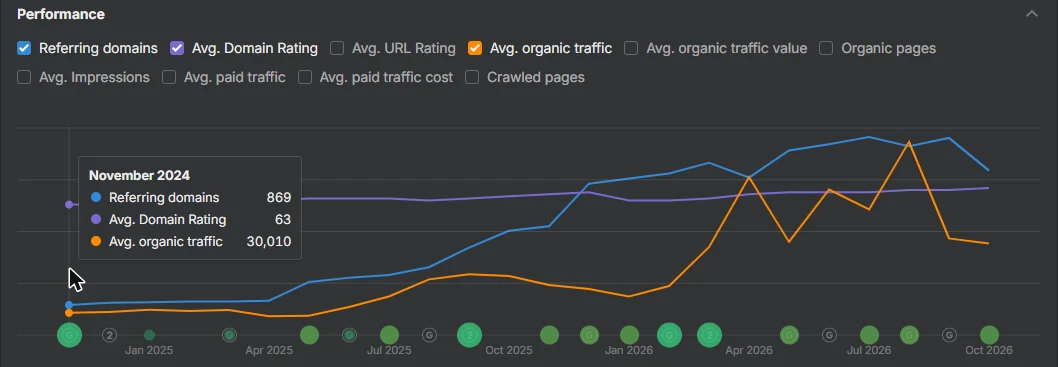
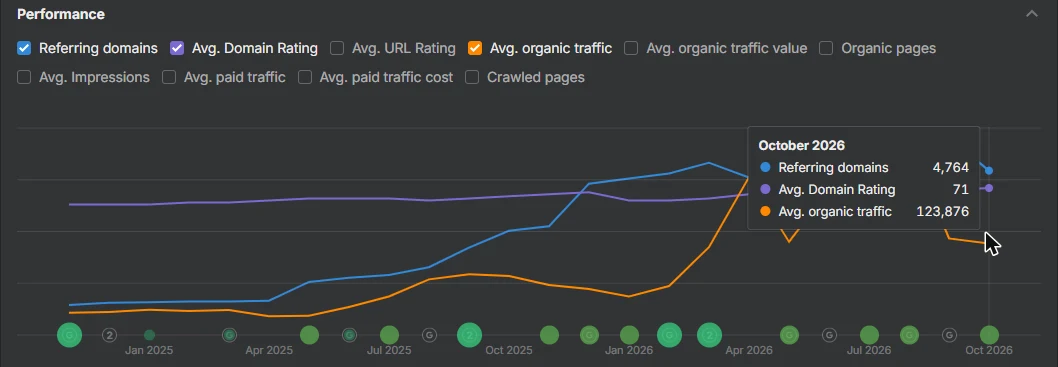
The traffic line did not follow the referring domain line month for month. It moved in bursts, sometimes months later. That matches the point of this post: links widen what a site can compete for, while content, rankings and the product decide when the traffic shows up.
These are Furqan Ashraf's in-house SEO projects, not Chung Digital client engagements. The figures are sitewide Ahrefs estimates and reflect combined SEO, content, product and technical work. Furqan's role focused mainly on off-page SEO, publisher outreach, backlink strategy and authority building.
How Chung Digital sizes link building for SaaS sites
We would rather start from the gap than from a package. The benchmark in this post is the conversation worth having before choosing a plan: which pages links should point at, how far they sit from the competition, and what pace fits the gap and the budget. Our link building packages map to that pace: Starter places 2 to 3 guest posts a month, Growth 4 to 5 guest posts plus a niche edit, and Authority 8 to 10 guest posts plus 2 niche edits.
Every placement is found through manual outreach and vetted before you approve it, and the monthly report shows what went live and where it points. If you want to see what we look for in each site, read how to evaluate backlink quality; for the tactics themselves, start with how to get backlinks for a SaaS company. None of this guarantees a ranking. It does mean you know the size of the gap and how fast you are closing it.
Frequently asked questions
Can a page rank with no backlinks at all?
Yes, for low-competition queries. Long-tail questions, narrow integration topics and docs pages often rank on content and internal links alone, especially on a domain that already has some authority. Competitive commercial keywords are a different story.
How many backlinks per month is safe for a new SaaS site?
Google does not publish a safe number, and any vendor quoting one is guessing. What matters is that the links come from relevant sites, use natural anchors, and grow at a pace that fits what your company is actually doing. A steady trickle of good links is safer than a large batch of weak ones.
Do nofollow links count toward the number I need?
For benchmarking, filter to followed links so you compare like with like. Nofollow links still have value: Google treats them as hints, and they bring referral traffic and brand exposure. Just do not count them as closing a followed-link gap.
Should I count links to my homepage when benchmarking a product page?
Count them at the domain level, not the page level. Homepage links strengthen the whole domain and some of that authority reaches the product page through internal links, but the page-level comparison should only use links pointing at the ranking URL.
How often should I re-run a backlink gap analysis?
Quarterly is a sensible default for priority keywords. Re-run it sooner if the search results change shape, a new competitor appears in the top ten, or your page moves noticeably in either direction.
Does Domain Rating tell me how many backlinks I need?
Not directly. Domain Rating is a sitewide, relative Ahrefs metric that Google does not use, so it cannot tell you what a specific page needs to rank. It is a rough proxy for domain strength, and page-level referring domains are the better planning number.
Why do some competitors outrank me with fewer backlinks?
Links are one input among many. A competitor with fewer links may match search intent better, cover the topic in more depth, have stronger internal linking, or benefit from brand searches. That is a sign to compare the pages, not just the link counts.
Do backlinks to my blog posts help my product pages?
They can, through internal links. When a linked blog post points to a relevant product or comparison page, some of its authority flows there. That only works if the blog post actually links to the commercial page in a natural way.