TL;DR
Domain Rating (DR) is Ahrefs' score for the strength of a site's backlink profile, while Domain Authority (DA) is Moz's score for how likely a site is to rank, and both run on a 100 point scale built from each vendor's own link index. Neither is used by Google, so the right question in the domain rating vs domain authority debate is not which one is correct, but which one you will track consistently. For most SaaS teams that means picking one tool, benchmarking against the competitors you actually lose rankings to, and watching referring domains and links to money pages alongside the headline score.
Domain rating vs domain authority: the short version
Both scores try to answer the same question: how strong is this site's backlink profile compared with everyone else's? They get there with different crawlers, different link indexes, and different math, which is why the same domain can show a noticeably different number in each tool.
| Domain Rating (DR) | Domain Authority (DA) | |
|---|---|---|
| Made by | Ahrefs | Moz |
| Scale | 0 to 100, logarithmic | 1 to 100, logarithmic |
| What it describes | The strength of a site's backlink profile relative to other sites in the Ahrefs index | A prediction of how likely a site is to rank, based mainly on link data from the Moz index |
| Main inputs | Unique referring domains with followed links, and how strong those linking domains are | Linking root domains and other link signals, combined in a machine learning model |
| Page level version | URL Rating (UR) | Page Authority (PA) |
| Used by Google? | No | No |
Semrush has a third score, Authority Score, that blends link data with traffic signals. The same logic applies to it: useful for comparison inside one tool, meaningless as a number to compare across tools.
How Ahrefs calculates Domain Rating
Ahrefs describes DR as the strength of a website's backlink profile compared with the other sites in its database. In practice the calculation looks at which unique domains link to you with at least one followed link, how strong each of those domains is in turn, and how many other sites each of them also links out to. A strong site that links out to very few domains passes more of its weight than a strong site that links out to everyone.
Three details matter for SaaS teams reading the number:
- It counts domains, not links. Fifty links from one partner's site count as one referring domain. A sitewide footer link does not multiply your DR.
- Nofollow, ugc and sponsored links are excluded. They can still send traffic and build brand recognition, but they will not move DR.
- The scale is logarithmic and relative. Climbing from the low teens to the twenties is far easier than climbing from the sixties to the seventies, and your DR can slip when other sites grow faster than you do.
Because DR is purely a link score, it says nothing about content quality, traffic, or relevance. We go deeper on what actually moves it in how to increase domain rating.
How Moz calculates Domain Authority
Moz frames DA differently. Instead of describing link strength directly, DA is a prediction: Moz trains a machine learning model on how sites actually rank in search results, then scores every domain on how well its link profile matches the profiles of sites that rank well. Linking root domains are the biggest input, but the model weighs several link signals together.
That framing has two practical consequences. First, DA can shift when Moz retrains or revises its model, even if your link profile did not change. Second, DA is more of a modelled estimate than a count, so it can react to patterns (like a profile that looks manipulated) in ways a simpler formula would not.
Moz positions DA as a comparative metric, the same way Ahrefs positions DR. A DA score on its own tells you little. It becomes useful next to the DA of the sites you compete with.
Moz domain authority vs Ahrefs domain rating: why your scores don't match
Founders often notice their DR and DA sit far apart and assume one tool is broken. Usually both are working as designed. The gap comes from three places.
Different link indexes
Each vendor runs its own crawler and keeps its own database of links. A link that Ahrefs has found may not be in Moz's index yet, and the reverse. Small and young SaaS sites feel this most, because a handful of discovered or missed links makes a visible difference at the low end of the scale.
Different math
DR is a formula over referring domains and their strength. DA is a model trained to predict rankings. Even with identical link data, the two would not produce the same number, because they are not measuring quite the same thing.
Different update timing
Ahrefs recalculates DR frequently as its crawler finds and loses links. Moz updates on its own schedule and occasionally revises the model behind DA. Both vendors have changed their formulas over the years, so a long historical chart can show jumps that reflect a methodology change rather than anything you did.
The fix is simple: never compare a DR to a DA, and never compare your score in one tool to a competitor's score in another. Pull every number you compare from the same tool, on the same day.
What is a good domain rating for a SaaS site?
There is no universal good score. A good domain rating is one that is competitive for the keywords you want, in your category, right now. A developer tools startup going after long tail technical queries can rank well with a modest DR, while a CRM competing for broad commercial terms is up against some of the strongest domains on the web.
To find your own benchmark, run this exercise once a quarter:
- Pick five to ten commercial keywords that matter to pipeline, such as your category term, a few "alternatives" queries, and an integration or use case query.
- Look at the domains ranking on page one for each. Note their DR (or DA, if Moz is your tool) in a simple sheet.
- Separate the giants (review platforms, huge publishers, the category leader) from the sites that are actually your size. The second group is your real benchmark.
- Note the range of scores among sites in that second group that still rank. That range, not a round number, is your working target.
- Check whether those sites rank with strong content and modest authority, or with modest content and big authority. That tells you whether your gap is links, content, or both.
- Repeat the check every quarter, since the benchmark moves as competitors build links too.
If you land well below the range, link building is probably the constraint. If you sit inside it and still don't rank, the problem is more likely content, intent match, or technical issues, and more links alone will not fix it.
What SaaS teams should track instead of a single score
DR and DA are fine as a quick read on overall link strength. They are poor as a goal on their own, because a score can rise from links that do nothing for your business. Pair the headline number with metrics that describe the quality and direction of your links.
- Referring domains over time: is the count of unique sites linking to you growing month over month, and is the growth steady rather than a sudden spike?
- Links to money pages: how many referring domains point at your product, integration, comparison, and pricing pages, not just the homepage and one viral blog post?
- Relevance of linking sites: are new links coming from sites your buyers read, such as SaaS, developer, security, or B2B publications, or from general sites with no audience overlap?
- Organic traffic of linking sites: a site with real search traffic is a much better sign than a high score with almost no visitors, which often points to a link seller.
- Lost links: which referring domains dropped off, and is anything worth reclaiming?
- Ranking and pipeline movement on target pages: the score is a leading indicator, rankings and sign ups are the outcome you actually care about.
We covered why relevance and editorial context beat raw authority in why backlinks still matter for SaaS SEO. The short version: a link from a smaller site your buyers trust can be worth more to a SaaS company than a link from a bigger site nobody in your market reads.
When to use DR or DA as a filter
Authority scores are most useful as a first pass filter when vetting link opportunities, a quick way to skip sites with almost no link equity. They should never be the last filter. A vendor that quotes only DR when pitching placements is skipping the questions that matter: does this site have real traffic, a real editor, and readers who overlap with your buyers? Our guide to link building vs. guest posting covers the other red flags worth checking before you pay for a placement.
Which one should your team pick?
Pick the tool you already pay for and will open every month. Consistency matters more than which score is theoretically better. Switching tools halfway through a year breaks your trend line, and the trend is the only part of the number that tells you much.
If you are choosing from scratch, Ahrefs DR is the more common shorthand in link building conversations, so it is what most publishers, agencies, and vendors will quote. That makes it convenient for vetting placements. DA is equally valid as a trend metric if Moz is the tool your team prefers for everything else.
Whichever you choose, write down what you will report alongside it (referring domains, links to money pages, ranking movement on target pages) so the score never becomes the goal by itself.
What a DR score looks like in Ahrefs
Here is the Ahrefs overview for IPGeolocation.io, an in-house project of our founder, captured on October 27, 2026. It shows DR 72, 4.8K referring domains and 13.1M backlinks.
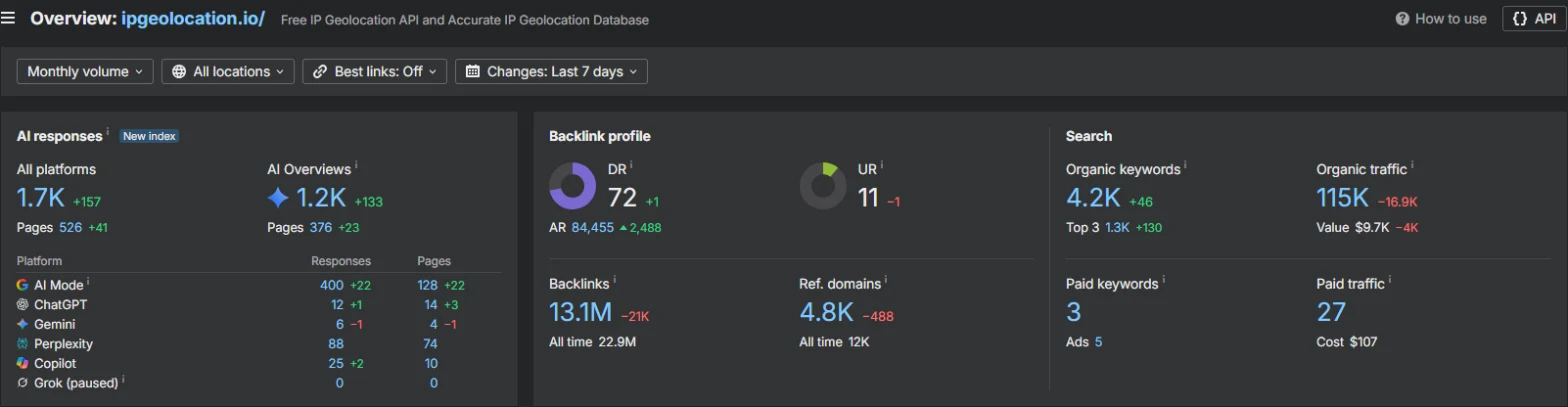
Look at how far apart the two link numbers are. One domain can send thousands of backlinks, so a huge backlink count says little on its own. DR follows unique referring domains and their strength, which is why we track referring domains first.
These are Furqan Ashraf's in-house SEO projects, not Chung Digital client engagements. The figures are sitewide Ahrefs estimates and reflect combined SEO, content, product and technical work. Furqan's role focused mainly on off-page SEO, publisher outreach, backlink strategy and authority building.
How Chung Digital uses DR in practice
We use Domain Rating as a vetting floor and a trend line, not as a promise. Every Backlinks tier sets a DR range for placements, DR30 and up at Starter and mixed DR ranges at Growth and Authority, because a floor screens out sites with no link equity at all. Above the floor, publishers are vetted manually for relevance to SaaS, API, or B2B tech readers and for signs of a real audience, not just a score.
Monthly reports list every live URL, anchor, and date, so you can track referring domains and links to your target pages yourself in whichever tool you prefer. If you want that work handled for you, that is what our SaaS link building agency does month to month.
What we won't do is promise a specific DR, DA, or ranking by a date. Scores are third party estimates that shift with each vendor's index and formula, and rankings depend on far more than links. Nobody can guarantee either honestly.
Frequently asked questions
Does Google use Domain Rating or Domain Authority?
No. Both are third party metrics made by Ahrefs and Moz, and Google has said it does not use them. They are useful as rough proxies for link strength, but Google runs its own systems and does not see either score.
Is Domain Rating more accurate than Domain Authority?
Neither is more accurate in any absolute sense, because each one reflects its own vendor's link index and method. Accuracy here means consistency: pick one tool, compare sites within it, and watch the trend over time.
Does a higher Domain Rating mean more organic traffic?
Not necessarily. DR only measures links, while traffic depends on how many keywords your pages rank for, how much those keywords are searched, and whether your content matches intent. A site can raise its DR and see flat traffic if its content and target pages are not ready.
Can a website have a high DR but low traffic?
Yes, and it is a common warning sign. Sites built to sell links often have inflated authority scores with almost no organic visitors. Always check a site's traffic and audience before treating its DR as proof of quality.
How is Semrush Authority Score different from DR and DA?
Semrush Authority Score also runs on a 100 point scale but blends link data with traffic signals. Like DR and DA, it is only meaningful when you compare sites inside Semrush, not against a score from another tool.
Why did my Domain Authority change when I did not build any links?
DA is a model, so it can move when Moz updates its index or revises its methodology, or when other sites in the index change. Small movements without a clear cause are usually noise and not worth chasing.
Is domain age related to Domain Rating?
Not directly. DR is calculated from referring domains and their strength, not from how long a domain has been registered. Older sites often have higher scores simply because they have had more time to earn links, and domain age is not a Google ranking factor either.
Should I compare my DR with my competitors' DA?
No. The scales look similar but the inputs and math differ, so the comparison means nothing. Pull every score you compare from the same tool on the same day.