TL;DR
Topical authority is how strongly search engines, and now AI answer engines, treat your site as a reliable, thorough source on a specific subject, earned by covering that subject in depth, connecting the pages well, and being referenced by other sites in the same space. It is not a score Google publishes; it is shorthand for a pattern where sites that cover a topic completely find it easier to rank each new page within it. For a SaaS site, you build it by mapping the topics your buyers search around your product, publishing a connected cluster for each one, and finishing one cluster before starting the next.
What is topical authority in SEO?
Topical authority describes how much a site is trusted on a particular subject, as opposed to how strong it is overall. A site with a modest backlink profile that covers API rate limiting from every angle can outrank a much bigger general tech blog on rate limiting questions, because it looks like the more complete source.
It is worth being precise about what is known. Google has not published a topical authority ranking factor or score for ordinary websites. It has publicly described a topic authority system for news publishers, and its guidance on helpful content asks whether a site has a primary purpose or focus and whether its content shows first-hand expertise. Topical authority SEO is the practical response to that: build a site whose focus and depth are obvious from its structure.
Any topical authority score you see inside an SEO tool is that vendor's estimate, in the same way Domain Rating is an Ahrefs estimate. Useful for comparison, but not something Google reads.
Why topical authority matters for SaaS SEO
SaaS companies rarely win by publishing more than everyone else. They win by owning a few subjects their buyers care about. Topical authority is what makes that strategy pay off in four ways:
- New pages in a covered topic tend to get indexed and ranked faster, because the site already has context and internal links for them.
- Commercial pages benefit. A comparison or integration page sitting inside a strong cluster gets relevant internal links and clearer context than a page standing alone.
- A focused site can compete with much bigger competitors on narrow, high-intent subjects, which is where most SaaS revenue comes from.
- AI answer engines need sources that explain a subject clearly and consistently. Being the site that covers a topic thoroughly improves the odds of being cited.
Topical authority vs. domain authority
The two get confused because both use the word authority. They describe different things and are built in different ways.
| Topical authority | Domain-level metrics (DR, DA) | |
|---|---|---|
| What it describes | Depth and trust on one subject | An estimate of overall link strength |
| Who measures it | No official score; inferred from rankings and coverage | Ahrefs (Domain Rating) and Moz (Domain Authority) |
| Mainly built by | Content coverage, internal links, relevant links and mentions | The number and strength of linking domains |
| Used by Google | Google describes topic understanding, not a published score | No, Google does not use DR or DA |
| Carries across subjects | No, it is specific to a topic | Partly, link strength helps every page somewhat |
You need both. Strong links with scattered content leave rankings on the table, and deep content with almost no links struggles on competitive terms. Topical authority is mostly an on-site job, while link strength is mostly an off-site one, covered in our guide to off-page SEO strategies for tech companies.
The building blocks of topical authority
Coverage
Coverage means answering the questions a buyer would expect a real expert to answer, including the unglamorous ones. For a secrets management product that might mean what secrets sprawl is, how rotation works, how to handle secrets in CI pipelines, how the main approaches compare, and how to migrate between them. Gaps are obvious to readers and, we think, to search engines too.
Structure
Each topic needs a pillar page that gives the full overview, plus supporting pages that go deep on one subtopic each. The pillar links to every supporting page, each supporting page links back to the pillar and to closely related siblings, and the cluster links to the product page where the product is the natural next step. One subtopic, one URL.
Depth and first-hand expertise
SaaS companies have an advantage most publishers lack: they know the problem from the inside. Real configuration examples, screenshots, code that runs, edge cases from support tickets, and honest trade-offs are what separate a credible page from a rewritten summary of the top results.
External references
Links and mentions from sites in the same subject area reinforce what your content claims. A link to your rate limiting guide from an API engineering blog says more about your authority on rate limiting than a link from a general news site.
How to build topical authority for a website, step by step
This is the process we use for SaaS sites. It works best when one person owns the topic map and every new page is checked against it.
- Pick two to four core topics where your product is a genuine answer. Broad themes like marketing or productivity are too wide; aim for the problem your product solves and the jobs around it.
- Build a topic map for each one. Pull subtopics from keyword research, related questions in search results, sales call notes, support tickets, internal docs searches, and the sitemaps of the sites that rank well.
- Group the subtopics into clusters and choose one pillar page per cluster. Mark which pages already exist, which need rewriting, and which are missing.
- Assign one URL per search intent. If two existing pages target the same intent, merge them and redirect the weaker one before adding anything new.
- Finish one cluster before starting the next. A complete cluster of a dozen pages usually does more than the same pages spread across five half-built topics.
- Wire the internal links as you publish: pillar to every supporting page, supporting pages back to the pillar and to close siblings, and the cluster to the matching product, use case, or integration page with descriptive anchors.
- Earn outside references for the pillar and the strongest supporting pages, through partners, communities, and editorial links in the same subject area.
- Review each cluster every few months. Update outdated pages, fill new gaps, and prune or merge pages that never found an audience.
Each new page still needs sound on-page basics. Our on-page SEO checklist for SaaS covers titles, headings, and internal links, and the on-page SEO checker tests a live URL against it. For how the content plan connects to pipeline, see content marketing for SaaS SEO.
Topical authority mistakes SaaS sites make
- Writing about everything adjacent. An API company publishing generic remote work tips dilutes its focus and attracts readers who will never buy.
- Publishing thin pages at scale. Hundreds of templated pages that say little each tend to drag a topic down rather than lift it.
- Leaving clusters orphaned. Pages that nothing links to are hard for search engines to find and harder to understand in context. We covered this in technical SEO mistakes slowing down SaaS sites.
- Creating several pages for one intent, so they compete with each other and none ranks well.
- Cutting docs off from the rest of the site. Documentation is often a SaaS company's deepest content on its core topic. When it lives on a separate setup with no links to and from the main site's guides, that depth is wasted.
How to tell if your topical authority is growing
There is no single number to watch, so use a few proxies together:
- In Search Console, filter queries with a regular expression for your cluster terms and watch impressions and the count of distinct queries over time.
- Compare how quickly new pages in a cluster get indexed and reach the first two pages of results, against pages you published earlier in the same cluster.
- Check whether each page ranks for a growing number of long-tail queries, not only its target keyword.
- Ask AI answer engines the same set of cluster questions each month and note whether your brand or pages appear.
- Look for links your cluster pages earned without outreach. Other writers citing you is a strong sign you have become a reference.
What topical depth looks like in Ahrefs
IPGeolocation.io, where Furqan works in-house, is built around one tightly defined topic: IP geolocation and the developer use cases around it. On October 27, 2026, Ahrefs showed it ranking for 4.2K organic keywords, 1.3K of them in the top 3, with about 115K estimated monthly organic traffic.
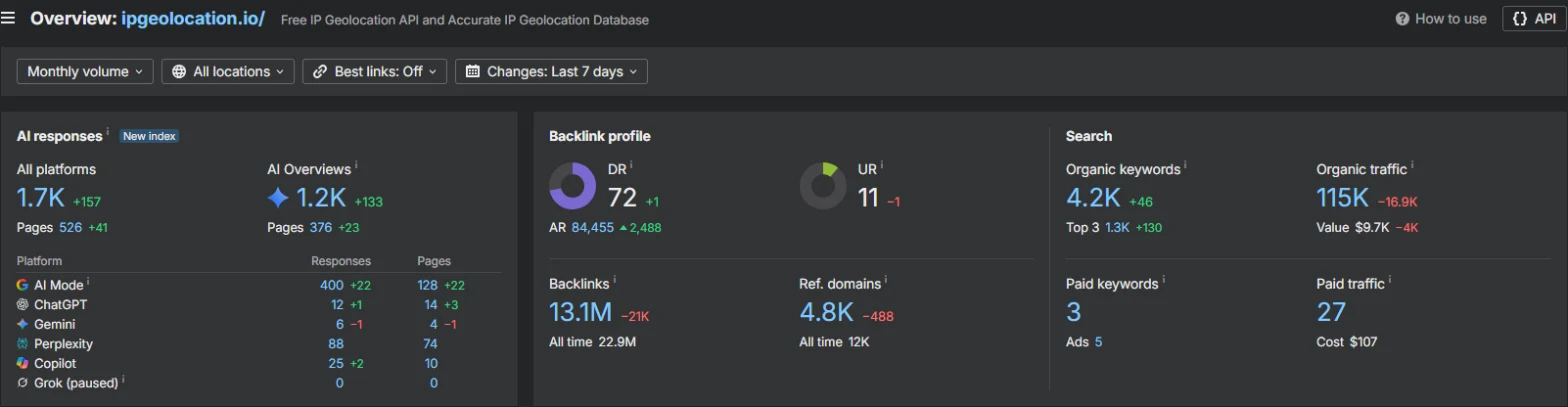
Nobody can honestly separate how much of that comes from topical focus versus links, product and brand. What the profile does show is the pattern this post describes: a large set of related keywords ranking together, not a few isolated wins.
These are Furqan Ashraf's in-house SEO projects, not Chung Digital client engagements. The figures are sitewide Ahrefs estimates and reflect combined SEO, content, product and technical work. Furqan's role focused mainly on off-page SEO, publisher outreach, backlink strategy and authority building.
How Chung Digital builds topical authority for SaaS sites
Topical authority sits inside our SaaS SEO services because it needs technical, on-page, content, and link work to move together. We start by mapping your core topics against what you already have, fix and consolidate existing pages, then add new ones cluster by cluster. The Growth tier includes one new blog post a month and the Authority tier two, alongside on-page optimization of existing pages and backlinks every month.
It is slow work, measured in quarters, and nobody can guarantee rankings from it. What it gives you is a site whose focus is obvious to readers, search engines, and AI tools, and that tends to keep paying off long after each page is published.
Frequently asked questions
How long does it take to build topical authority?
Usually several months for a single cluster, and longer in competitive spaces. It depends on how much useful content you already have, how quickly new pages get indexed, and how strong your competitors are. Judge progress over quarters, not weeks.
How many articles do you need for topical authority?
There is no fixed number. You need enough pages to answer the questions a buyer would reasonably ask about the topic, without splitting one intent across several URLs. For a narrow SaaS topic that might be a dozen pages; for a broad one, far more.
Is topical authority a Google ranking factor?
Not as a published, named factor for general websites. Google has described a topic authority system for news, and its guidance rewards focused, expert content. Topical authority is best understood as the outcome of doing those things well rather than a setting you can switch on.
Can a new SaaS site build topical authority?
Yes, and narrow focus is a new site's best advantage. Pick one topic close to your product, cover it thoroughly, and link the pages well. A young site rarely wins broad terms early, but it can become the clear reference on a narrow subject.
Does topical authority help with AI search?
It helps the odds. AI answer engines look for sources that explain a subject clearly, and a site with consistent, in-depth coverage gives them more to work with. Scattered, shallow content makes a citation less likely.
Do I still need backlinks if I have strong topical authority?
Yes, especially for commercial keywords. Topical authority helps search engines understand what you are an expert in, while links signal how much the wider web trusts you. On competitive terms, sites usually need both.
Can you lose topical authority?
It can fade. Outdated pages, a site that drifts into unrelated subjects, or competitors publishing deeper coverage can all erode it. Regular updates and pruning keep a cluster current.
Which tools measure topical authority?
Some SEO tools offer their own topical scores, but these are vendor estimates, not Google data. Search Console query data filtered by topic, plus rankings across a cluster, gives a more honest picture of how a topic is performing.