TL;DR
To get cited by ChatGPT, make sure OAI-SearchBot can crawl your site, rank in the search results ChatGPT pulls from, publish pages that answer buyer questions in plain and specific language, and get your brand onto the third-party sites ChatGPT already cites for your category. That last step matters most for recommendation prompts, because ChatGPT tends to build "best tool for X" answers from review sites, comparison articles, community threads and publications rather than vendor homepages. The fastest way in is to work backwards: find the pages ChatGPT cites for your prompts today, then earn a place on them or build something better. Nobody can guarantee a citation, but this playbook improves your odds and shows you where the gaps are.
Start with the prompts you want to be cited for
"Get cited by ChatGPT" is too vague to act on. ChatGPT cites different kinds of pages for different kinds of questions, so the first job is deciding which questions matter. For a SaaS brand, buyer prompts fall into a handful of types, and each one points to a different lever.
| Prompt type | Example | What tends to get cited | Your main lever |
|---|---|---|---|
| Category discovery | Best uptime monitoring tool for startups | Comparison articles, review sites, community threads | Third-party coverage |
| Head to head | Tool A vs. Tool B for a small team | Comparison pages, reviews, vendor pages | Your own comparison page plus reviews |
| Alternatives | Cheaper alternatives to Tool A | Alternatives roundups, forums, review sites | Inclusion in roundups, your alternatives page |
| Problem or how-to | How to rotate API keys without downtime | Official docs, technical blogs, Q&A sites | Docs and technical content |
| Brand questions | Does Tool A support SSO on its cheapest plan | Your pricing page, docs, review profiles | Clear, current facts on your site |
Write a list of prompts across these types, weighted toward the ones closest to a buying decision. That list is what you will test, build for and measure against for the rest of this playbook.
Top sites cited by ChatGPT: the types that keep showing up
People often ask for a ranked list of the top sites cited by ChatGPT. Any fixed list goes stale quickly, and which sites dominate depends heavily on the topic and on how the question is phrased. What holds up better is the pattern of site types that keep appearing. Check your own prompts to see which specific domains lead in your category.
Encyclopedic references
Wikipedia and similar reference sites get cited for definitions and background facts. Most SaaS companies don't qualify for their own Wikipedia article, and creating one for promotion breaks Wikipedia's rules. The realistic lever is being notable enough to be referenced accurately in articles about your category, which comes from independent coverage, not editing.
Forums and community threads
Reddit, Stack Overflow, Hacker News, GitHub discussions and niche communities get cited when a question is about real experience: what people actually use, what broke, what's worth paying for. A SaaS brand earns a place here by having real users talk about it and by team members answering questions helpfully under their own names with their affiliation disclosed. Seeded fake reviews and sock-puppet accounts tend to get removed and can damage the brand they were meant to help.
Review and comparison sites
Software review platforms such as G2, Capterra and TrustRadius, along with independent comparison and "best tools" articles, are a common source for recommendation prompts. A complete, current profile with real reviews, plus accurate inclusion in the comparison articles that rank for your category, is often the single biggest lever for "best X" prompts.
Major publications and trade media
Established news sites and industry publications get cited for trends, announcements and expert takes. Coverage here comes from digital PR, contributed articles, expert commentary and original data worth reporting on. Note that OpenAI has content partnerships with some news publishers, which is one more reason publication coverage tends to surface.
Official docs and vendor sites
For technical and brand-specific questions, ChatGPT regularly cites official documentation, pricing pages and vendor blogs, including yours. This is the one category you fully control, which makes it the place to start.
How to get cited by ChatGPT: the step-by-step playbook
The order matters. Early steps remove blockers; later steps build visibility. If you want the reasoning behind each step, we explain the mechanics in how ChatGPT chooses which sources to cite.
- Confirm access. OAI-SearchBot must be allowed in robots.txt, your CDN or firewall must not be blocking it, and the content you want quoted must be in the server-rendered HTML.
- Check your search footprint beyond Google. ChatGPT search relies on third-party providers, and Bing is widely understood to be one of them, so verify your site in Bing Webmaster Tools, submit your sitemap and confirm your key pages are indexed there.
- Run your prompt list in ChatGPT with search on, several times per prompt, and record every cited URL. This is your citation map.
- Sort the citation map into the site types above. If review sites dominate, that is where your effort goes. If docs dominate, your own technical content is the priority.
- Fix or build the owned pages that match what gets cited, covered in the next section.
- Work the third-party pages on your citation map: ask authors of cited comparison articles to include or correct your product with accurate details, complete your review profiles, and pitch publications that already appear.
- Keep every fact consistent. Pricing, plan limits, integrations and your one-line description should match across your site and every profile you control.
- Update pages when the facts change, and only then. Changing a date without changing the content doesn't make a page fresh.
- Re-run the same prompts monthly and track how often you are cited, mentioned or recommended over many runs, alongside chatgpt.com referral visits in analytics.
Steps 3 and 4 are the easiest to skip, and they are what make the rest efficient. Without a citation map you end up guessing which pages to build and which sites to pitch.
Owned pages that give ChatGPT something to cite
Your own site will rarely be the only source for a recommendation, but it is often the best source for the facts underneath one. These are the page types that most often earn a ChatGPT citation for SaaS brands.
Comparison and alternatives pages
A fair, specific comparison of your product against named competitors answers head-to-head and alternatives prompts directly. The word fair matters: a page that admits where a competitor is the better fit reads as a source, while one that declares you the winner on every row reads as an ad.
Pricing and plan limits in plain text
Brand questions about cost, seats, usage limits and which plan includes which feature come up constantly. If your pricing page hides numbers behind "contact sales" or renders them only in an interactive widget, ChatGPT will take the answer from a review site or an old blog post instead, accurate or not.
Docs, integration and use-case pages
Technical prompts get answered from documentation. Docs that state what the product does, with which systems, under which limits, in crawlable text, are among the most citable pages a SaaS company owns. Use-case pages work the same way for prompts like "tool for X in industry Y", as long as they say something specific about that use case.
Original data and clear definitions
If your product sits on data others don't have, publishing aggregate findings or benchmarks gives both ChatGPT and other writers a reason to cite you. A clear definition of a term in your niche, stated in the first sentence, does a smaller version of the same job.
Mistakes that keep SaaS brands out of ChatGPT answers
- Blocking OAI-SearchBot by accident while trying to block GPTBot, or blocking every AI crawler in one rule.
- Putting the most useful content in gated PDFs, login-only docs or client-rendered widgets that crawlers can't read.
- Describing the product in different words on every profile, so no source agrees with any other.
- Self-published "best tools" lists that rank your own product first with no honest comparison. Buyers discount them, and they give a model little reason to treat the page as neutral.
- Astroturfing communities. Undisclosed promotion on Reddit or similar sites tends to get removed and can turn the thread against you.
- Optimizing for one prompt and one screenshot instead of a prompt set measured over time.
ChatGPT is only one assistant. Google's AI features run on a different pipeline with their own documented rules, which we cover in how to rank in AI Overviews. The good news is that most of this playbook carries over, and the wider shift is laid out in AI answer engines are the new search results page.
A reality check from real AI citation data
Here is how AI responses split across platforms for WHOISFreaks, an in-house brand where Furqan works on off-page SEO, in Ahrefs on October 27, 2026. Ahrefs counted about 2K AI responses across all tracked platforms, including 1.4K in Google AI Overviews and 278 in Perplexity, but only 5 in ChatGPT.
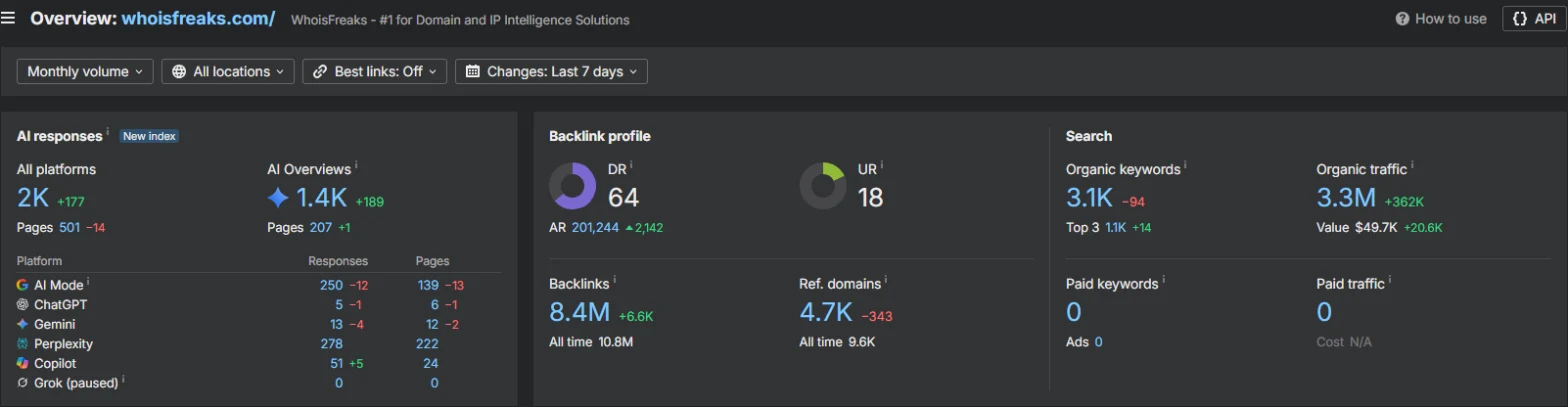
That gap is the useful lesson. Strong authority in Google does not carry over to ChatGPT on its own, which is why the playbook above treats ChatGPT as its own channel, with its own prompt list and its own sources to win.
These are Furqan Ashraf's in-house SEO projects, not Chung Digital client engagements. The figures are sitewide Ahrefs estimates and reflect combined SEO, content, product and technical work. Furqan's role focused mainly on off-page SEO, publisher outreach, backlink strategy and authority building. AI response counts are Ahrefs estimates from the prompts it tracks, and they are never the result of one person's work alone.
How Chung Digital helps SaaS brands get cited
Our Mentions service runs this playbook as a monthly program. As a generative engine optimization agency, we build your prompt set, run it across ChatGPT, Gemini, Perplexity and AI Overviews, and map which third-party pages are cited in your category. Those pages become the targets for brand mention placements, and from the Growth tier up we add a competitor citation gap analysis plus entity and schema work on your own site.
We report what changed, prompt by prompt, every month. We don't promise a number of citations, because nobody can control what ChatGPT says. If you want to see how we'd track the results before starting, our guide to measuring AI visibility explains the method.
Frequently asked questions
How long does it take for ChatGPT to cite a new page?
For search-grounded answers, a page can be cited once it has been crawled and indexed by the search providers ChatGPT draws on, which can be a matter of days or weeks. Whether it actually gets cited depends on how it ranks and how well it answers the prompt. There is no fixed timeline.
Does ranking on Google help you get cited by ChatGPT?
Indirectly. The same qualities that help a page rank on Google, relevance, authority and clear content, tend to help it rank with other search providers too. But ChatGPT search does not simply mirror Google, so check your visibility in Bing as well.
Can I submit my website to ChatGPT?
There is no submission form for ChatGPT search. The practical equivalent is allowing OAI-SearchBot in robots.txt, making sure your pages are indexed by major search engines, and keeping a clean sitemap so new pages are discovered quickly.
Do I need a Wikipedia page to get cited by ChatGPT?
No. Most SaaS brands are cited from their own docs, review profiles, comparison articles and community threads, not Wikipedia. Wikipedia has strict notability and conflict-of-interest rules, so creating a page for your own company is rarely possible or wise.
Will an llms.txt file help ChatGPT cite my site?
There is no confirmation from OpenAI that it uses llms.txt to choose sources. It is a proposed convention and harmless to add, but it won't replace crawler access, search visibility or useful content.
Should I write content specifically for ChatGPT?
Write for buyers, structured so a machine can extract it. Clear answers, specific facts and honest comparisons serve both. Content written only to game AI answers tends to be thin for readers and offers little a model can confidently cite.
How do I know if ChatGPT is sending traffic to my site?
Links from ChatGPT search carry utm_source=chatgpt.com, and visits also show chatgpt.com as the referrer. Set up a filter or channel group in your analytics for these so AI referral traffic is tracked separately from other referrals.
Is getting cited by ChatGPT worth it if few people click?
Usually, yes. Being cited or recommended puts your brand in front of a buyer at the moment they are forming a shortlist, even if they don't click. Many will search for your brand directly afterwards, which shows up as branded search or direct traffic rather than a ChatGPT referral.